Tuesday, June 16, 2020

How do you get rid artist's block?


What is artist’s block and how do you get rid of it?

If you have never experienced a creative block the best way that I can describe it is to compare it to constipation.  I know that sounds gross, but it is pretty accurate.  I have been really sick this past year, so as a result I had a yearlong block.  This is especially exasperating when you take into consideration that my studio is only the next room over from my bed.
"Light Blue and Orange" 12 x 16 oil
One of the three oils that I found hiding behind the furnace

"Orange Weeping" 18 x 24
One of the first things I do if I am blocked on a specific piece is to “marinade” it.  I put it into a portfolio for a day or a few weeks if I can.  Once I put 3 oil paintings behind the furnace and forgot about them.  I was so frustrated with the process I decided I wouldn’t dabble in oil again but I could not let them go. 

Later I found them, back behind the kitty litter and a few empty boxes.  After cleaning them up and making some minor changes I entered them into two shows.  The 3 pieces won best of show for an exhibition in Richmond at the Crossroads Art Center.  Then, the 3 pieces won another high award at Charles Taylor Art Center in which the smallest one sold. My advice to my students is to never throw away your unfinished works.  They may not be as bad as you think.
"Listening to Shining Star by Earth Wind and Fire" 18.5 x 25.5

My most recent work is called Listening to Shining Star, shown above. It took me a year to do because I was blocked and also very physically ill.  I finally finished it yesterday just in time to put it into a show.  I hope it is accepted it gets in, but mostly I am just glad its done.

I will talk about this issue again in a future post where we will discuss "How do I know if it is done?"


Monday, June 15, 2020

Is this your real job?


Self-Portrait with Beret and Turned-Up Collar
"Self Portrait with Beret and Collar Turned Up Collar"  Rembrandt 1659


Is this your real job?

I only take art related jobs.  When those jobs morph into a non-artist job, I lose interest and soon enough I start getting those nudges from God to leave. So, as you can imagine, my income is unpredictable. 

Here’s a funny story.  Once I took a job as a cashier for some friends of mine that had a craft store in the Williamsburg Mall in Virginia.  It was minimum wage, but we were broke so I took it.  One day Bill, the owner, accidentally scheduled 2 people on a Saturday afternoon, so he sent me home.  I asked if I could plop my easel down near the window of his store since I always kept my quick sketching stuff in the car.  I agreed to pay him 25% commission, which is actually very low.  I didn’t think I would do much, but he and his wife Jill had so much faith in me, they new I could do it. It turned out that this mistake on the schedule was one of those Godly nudges.  I made around $300 in about 3 hours that day so he fired me.  I sketched for he and his wife Jill for 9 years after that on Saturdays.

Most full-time artists do other art jobs.  They might work in a gallery or an art store.  They might do dog portraits.  They could be caricature artists or quick profile portrait artists at Busch Gardens. Perhaps they work as an art teacher. My friend Rita Kirkman does it all.  We used to sketch together many decades ago at Busch.  She still does it at a mall during the holidays and at a few festivals.  I can certainly do a few quick sketches, but my days of making $1000 in a few hours at a festival are over. Most Saturdays in my prime I could do well over a hundred faces in around 9 hours, 5 days a week.  Now I have arthritis, no surprise there.  After work all of us artists would go out dancing and bring our sketch books with us.  It was a great job.

I replaced this income with doing painting parties.  They are very hard work, but I make it look super fun because they are usually drunk.  But hey, I have an income.  I also teach in galleries, from my studio, and in art centers.    
         .
Lady Elizabeth Angela Marguerite Bowes" By John Singer Sargent.  This may be an example of his quick portraits, or possibly a study for a painting.
Did you know why Rembrandt did so many self-portraits?  It is because he was a celebrity but he was also broke.  So, he would do self portraits and sell them!  Sorry I don’t remember where I read that.  John Singer Sargent apparently did his version of quick sketches in his studio for an extra income.  Not sure where I read that either, but I remembered it.If you are burning to know my references I can find them on my teetering bookshelf.

Also, keep in mind that making art is only a portion of what artists do.  Before Covid I averaged around 6 painting parties per month.  I have to do inventory, purchase, organize, prepare the canvases, make new easy canvases to teach, load the stuff into their containers then load that into the car, blah blah blah.  You don’t want to hear the rest of my details.  I have an entire additional set of chores for my fine art classes. I do a tremendous amount of research for those.  My students in the fine art classes are sober, at least as far as I can tell, so I really have to be on the ball for them.

The point is that only a rather small chunk of time is left in my pre-covid life for making art that sings to me. I have many art friends, (I call them FARTS, Friends who make ArtS). and I have also read this about the financial and emotional struggle of master artists, most of whom also taught. So, to answer this humorous but very common questions, Yes.This is my real job, and I am ready for a vacation.

Friday, June 12, 2020

Where does talent come from?


Where Does Talent Come 
from?


How Michelangelo's Sistine Chapel became a Renaissance icon Michealangelo's "The sistine chapel, Creation of Adam" c1512

 I would like to address my readers with a few common misconceptions about full time working artists. I will answer these issues over the next few weeks.  I get asked many questions when I am doing a demo in public, drawing portraits from life at a park or teaching beginners.  

The first question that comes to mind is innocent enough. “Where did you get that talent?”  I hate this question.  Honestly my low Artesteem is either masked by the fact that I am my own marketing agent, or not masked at all and people think I am digging for compliments. When I am teaching I mask it well too.  " Uh yeah, I am so, like, awesome!"  (not). 
Leonardo Da Vinci's The Last Supper has a strange history ...
"Last Supper" by Da Vinci, c1490

I knew I was talented before I could draw.  I knew I had a gift before I could write.  This is not bragging, its just how I am.  I was also born with dimple in my chin and really thick hair too.  It just is how I was born.  My parents raised 7 children to be unique in 
their own ways, so they had 7 kids that looked very much alike, but were vastly different in personalities.  I did get the music bug from my Dad.  But even though I excelled at music at a very young age, I thought I would be a visual artist.  I prayed and prayed and cried as I tried my best to draw as a kid, but the best I could do was to scribble like most other people my age.  

Then, one magical day when I was around 12, I picked up my school pencil and some notebook paper and drew myself while looking into a mirror. I could draw but no one taught me how to do it. I freaked out.  What the heck?  That was the first time I felt my art angel over my shoulder guiding my hand.  I was spooked. My parents were flabbergasted.  No one in our family were visual artists.  “Where did this come from Emmy?” my Mom asked. Dad just stared speechless for a moment if I recall. I must have had the deer in the headlights look when I said, “I don’t know, I just drew it.” So, I think that answers the question for me anyway as to where my “talent” came from, it came from God and the universe. This means that no matter what, I have an obligation to use this gift.

Having this present from the universe means that I practice and study obsessively. I am a highly technical pastellist and painter.  This is the part that came from constant study spurred by my desire to be an artist. I teach the technical aspects of art.  The students supply their own talent and energy. Anyone can learn the techniques and the rules.  The talent supplies the fuel for the fire.

What makes one person talented and one person just technically able to draw you ask?  I believe firmly that I can teach anyone at all to “draw”.  I teach them a set of rules. They follow them or break them as needed.  The talent comes when things get tough.  You stick to it and make it your passion your purpose in life.  If I am on a roll I will work until 4 am, as I did last night.  I often dream about the drawing that I am working on. My ideas often come from dreams.  I power through the mistakes and let them form a new idea.  I dig deep into my own psyche and bare myself to the world through my art. This is the difference between talent and ability to draw, I think.  The talent is the bug in your head.  The talent is finding inspiration in anything and everything.  The talent is what causes artists to live, eat, breath art.  Its not bad if you don’t have “talent”, in fact perhaps you do and have not explored it yet.
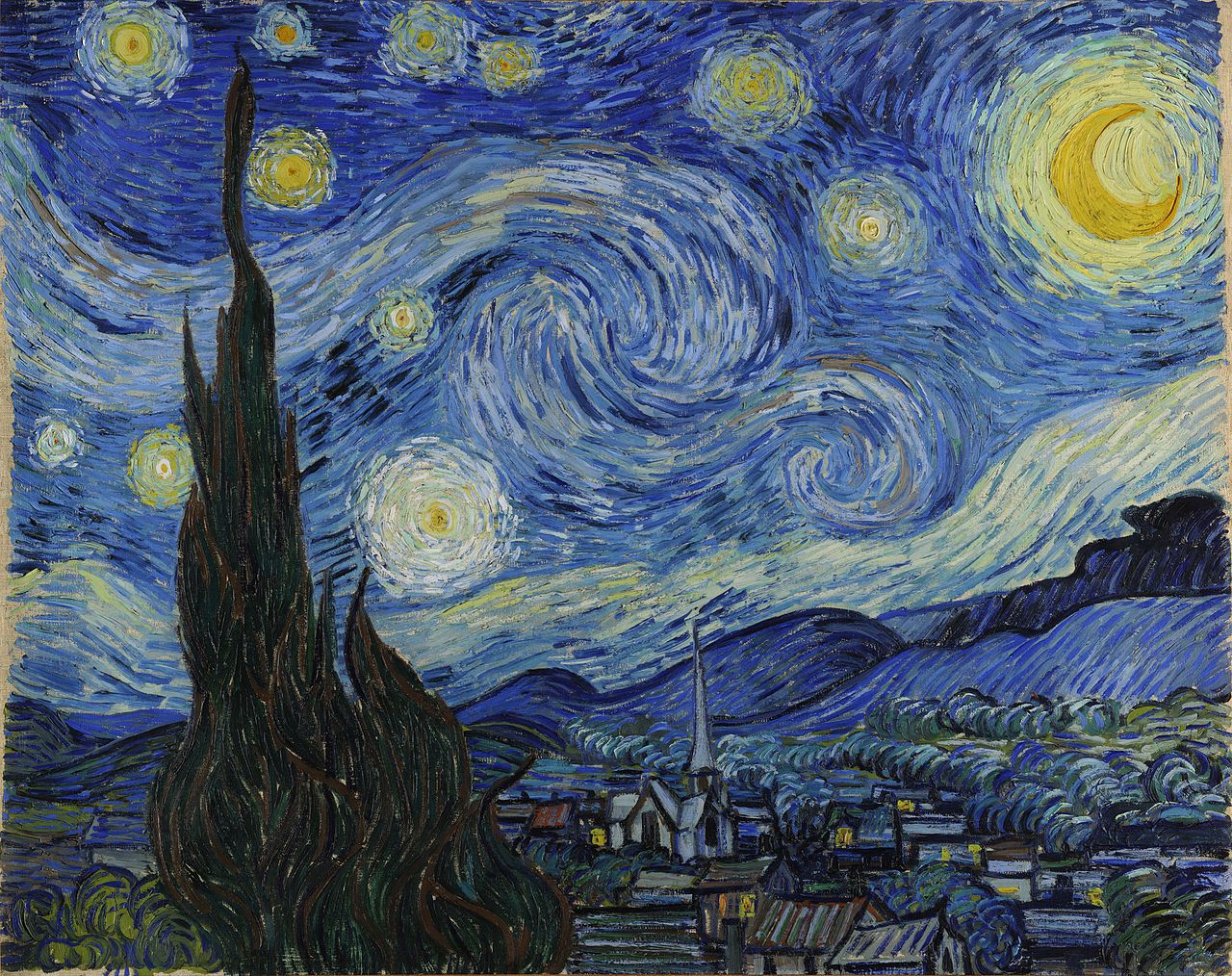
Van Gogh Starry Night - The Painting and The Story
"Starry Night" Van Gogh 1849

By the way please know that I would never compare my talent with that of the 3 artists I have included.  Above you can see the difference between 3 very gifted artists.  MIchaelangelo, Da Vinci and Van Gogh were all child prodigies.  Van Gogh however had no formal training as an artist.  He learned by friending other artists of his time, copying prints from his brother’s print shop then learning to add color later.  Michaelangelo and Da Vinci were trained from a very young age.  

You don’t need schooling to be talented.  You dont need talent to be schooled. You can learn on your own if you have the passion.  If you don’t have the passion, time or energy, just learn in little spurts when you can.  That is OK. Inspire yourself with crafting, as that uses a very similar mental process in my experience.  Try some beading, puzzles, scrapbooking or making crafts with the kids.  Its all the same type of energy expressed in different ways.  This theory is my own thoughts.  

If you have other theories please post them.  I love a healthy and polite debate.  If you have a question about common misconceptions , bring it on.

Peace,
Emily Christoff - Flowers
Emilychristoff.com
757-879-9795


Wednesday, December 5, 2018

Making Music with Art

"Strings 1" 8 x 10" Pastel and silver leaf

"Strings 2" 8 x 10"  Pastel and silver leaf

"Strings 3"  Pastel and Silver Leaf
For the past 3 years I have participated in the "mini" show at the art center where I teach pastels, The Charles Taylor Art Center, in Hampton Virginia.

As usual my art is inspired by music. I wasnt inspired this time by a specific song however but decided to use a few tricks often found in the works Paul Klee.  (http://www.paul-klee.org/music/) Klee infused his paintings with actual shapes found in music.

I created a matching set and put them in matching frames.  Notice that the frames have little bumpy silver things like the silver leaf in the drawings.


I choose the background because the shapes of the pattern mimics the shapes of a string instrument.  Originally the background was going to be dark gray over light gray, but at the last minute I made it a low intensity violet over gray.  I thought it would work with the violets and gold and orange hues found in the instruments.

The violet wall paper - like patterns represent the overall sound of the piece. If you look closely at the background you will see that they are textured with cross hatching to create consistency and "noise".  It also imitates the texture one might see in a wet painting on canvas.  I did not hatch the figures or the instruments in the same way.  I used a more fluid stroke there to move your eye about and give it some where to rest.

The large oval shapes represent the meter, or the downbeat.  Either the piece is in 3/4 or 4/4 time.  I moved the ovals across the composition to represent the progression of the downbeat through time.

The swirly organic shapes in the foreground represent the pitch or sound of a string instrument.  Again, they mimic the shape of a string instrument.  If you take a close look there is at least one shape from the top that merges with the patterned background. I always thought that all instrument sounds should alternate between merging and separation to create an interesting song.

The top pattern is transparent.  That was tricky to do in pastel by the way!  I added dots and some strokes of silver leafing to them to represent more intricate movements often found with string instrument in many musical compositions.

These little drawings were great fun.  I am going to have to go out and buy more instruments or find some models who can bring their own.  Any volunteers?

See more at:
Emilychristoff.com

Friday, November 23, 2018

Using mistakes to make something creative


"Lauren Christoff"  pastel on sanded paper 10 x 25"


There are many ways to approach creating a figurative drawing in pastel.  I think that my beginning students get frustrated because there really is no solid process or science to it, at least not in our world.  I do a lot of changing up on my own processes depending on the drawing. In fact most of my best works happen because I made a mistake or something went wrong and I had to approach my drawing from a different angle.  In this case I did not have a perfect photo to work from.  Its my own fault.  I am actually quite used to fuzzy photos.  Most of my portrait clients in the past have sent me horrible photos of things like the back of someone's head, or perhaps of an animal after it's passing. By this I mean that the photo was of a, uhhhh... deceased pet after the deceasing happened. In this case however, the poor photo choice was totally on me.

I wanted to do something fun of my niece Lauren.  When she came down from Ohio a year ago for a visit we spent an hour doing a detailed photo shoot.  We varied the outfits, location, lighting and moods.  Once she went home I searched for the memory card of her photo shoot.  It was GONE!  I blame my dog for eating it.  He eats everything.

So, I did what any good Auntie Em would do, I stalked her on facebook.  I never found one photo that excited me so I took my best bet and used a photo of Lauren and her Mom, my sister in law Sandi. Of course I asked permission first.  Since I know Lauren's face well I took liberties from the photo.  I dont do that with clients usually unless they specifically ask me to reduce a chin or two.

From this not so clear photo I did a thumbnail. Of course being the lazy cheat that I am, I did it on photoshop.  I flipped it, cropped it and reduced it to black and white.  I do a majority of my work from a black and white reference photo by the way.  After removing the color I could see the values more clearly so I altered the contrast and brightness to soften the harsher lights and bring out some details in the shadowed areas.  In cave man days we had to do all of this by hand.
As I mentioned before, there are so many processes to creating a pastel drawing. My advice is to mix it up and have fun. I often alter my steps and such to avoid burn out.  Sometimes I do a wet underdrawing, sometimes its dry.  Sometimes I tint the paper myself and sometimes I use pre tinted paper. In this particular drawing I first did a black and white value drawing using off white Uart sanded paper, keeping the layers thin.

When I was done with the values I added a thin layer of green.  The purpose of the green is that since it is the complementary color of most model's skin, it creates a beautiful glowing effect once I draw over it with other redish layers.  Greens and Reds make grays and browns once mixed or glazed together. The darker the skin of my model, the darker the values, but I still use green.  This is called "Verdaccio" and is most often used with oil painting.  I cant take credit for it. It was developed by early Renaissance artists.  If you take a close look at the Sistine Chapel, you will see part of the greenish gray under paintings used in the architectural elements. Just google "Michelangelo".
After the Green layer I add warm yellows to the highlights and cool tones such as blue to the shadows.  I soften some edges and sharpen others. The reason why I do this is because I want part of the face to stick out towards the viewer, and other parts to move to the back. When studying the element of "space" an artist learns that to make something look more 3 d, you make the shadows and distance areas softer, cooler and less defined to cause it to recede. You use texture, warm tones, and sharp edges to make that part of the object to advance.

Then, After establishing value, space, edge and spacial composition as stated above, I  take my time adding topical colors and such.  Topical colors is just a fancy artsypants way of saying "normal color"  After I get the hues (colors)  and values (shadows and bright spots) where I like them I go over it one last time and add some flowing texture with my pencils. These lines gives it life and makes it move and breathe. Its around this time that I will start to refer to the color photo. I usually start adding the odd reflective colors now too.

Most of this drawing was done using Stabilo pastel pencil.  Towards the end I used Rembrandt and Nupastel pastels to add her hair and background. If I finger blend I always top it with pencil texture since finger blending can turn layers of pastel into mud.


Well, thats about it.  I got the drawing done in time for her folks to display it at her graduation party.  One of these days I will find her photo shoot and do the full body drawing with all of the fancy swirls and gilding that I originally had in mind.  Unless of course my Pit/lab Albusdumbledog ate it.  Then I dont want the memory card back!